MSc thesis project proposal
[2026] Design of a Single-Fault-Tolerant Bidirectional Neuromodulation Implant System
Project outside the university
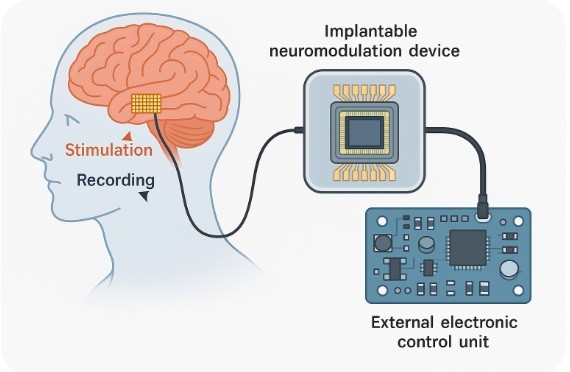
IMECTogether with imec, we are working on advanced neuromodulation technology has been developed that can both stimulate neural tissue and simultaneously record neural responses. This technology is based on state-of-the-art neuromodulation ASICs and is being extended toward both benchtop platforms for preclinical research and implantable bidirectional neural interfaces for in vivo studies.
Although the ASIC includes built-in active and passive charge-balancing mechanisms to improve safety, ensuring protection against unintended DC currents remains a critical challenge. These currents may arise due to component failures, system imperfections, or complex interactions with biological tissue. Addressing these challenges requires robust system-level design approaches.
This project focuses on developing design methodologies and architectural optimization strategies for a single-fault-tolerant neuromodulation implant. The work involves integrating imec’s existing technologies with selected off-the-shelf components into dedicated safety hardware blocks. These will be combined with a benchtop platform and the neuromodulation ASIC to form a complete, robust system.
The final prototype will be experimentally validated through in vitro and in vivo testing to assess safety, performance, and fault tolerance.
Assignment
The student will:
- Design and optimize the system architecture of a fault-tolerant neuromodulation platform
- Identify risks related to unintended DC currents and develop system-level protection strategies
- Integrate ASIC technology with external components into dedicated safety hardware blocks
- Perform PCB design and implementation
- Develop embedded firmware for system control and validation
- Build a functional prototype of the neuromodulation system
- Conduct experimental validation, including:
- In vitro testing
- (Potentially assisted) in vivo evaluation
- Analyze results in terms of safety, robustness, and fault tolerance
Requirements
- MSc student in Electrical Engineering (EE) or Biomedical Engineering (BME)
- Strong interest in medical devices / neural engineering
- Experience or affinity with:
- Analog and mixed-signal systems
- PCB design
- Embedded systems / firmware development
- Basic understanding of system-level design and safety considerations is advantageous
- Interest in experimental validation and interdisciplinary work (electronics + biology)
Contact
prof.dr.ir. Wouter Serdijn
Bioelectronics Group
Department of Microelectronics
Last modified: 2026-06-12